Better Bibles Blog has moved. Read our last post, below, and then
click here if you are not redirected to our new location within 60 seconds.
Please Bookmark our new location and update blogrolls.

Monday, July 16, 2007

Song of a Valiant Woman: 9

I haven't yet addressed whether the woman in Prov. 31 should be called a "woman" or a "wife". In Hebrew and Greek as well as French and German this distinction is not necessary. Most Bibles, however, call this woman a "wife" - the only exception I note is the JPS. (I would like to explain that the only reason I do not quote the NJPS is that I do not have a copy at this time.)

Looking at this passage from an historic point of view, it would be easy to say that the primary role of the Jewish woman was to be a wife and bear sons, and point out that this passage refers to finding a wife. However, it is not so simple. Ruth was an אֵשֶׁת-חַיִל ishet hayyel, as a widow. That is, the woman has these characteristics already and this made her desirable as a wife. Rahab also had the most basic characteristic of the אֵשֶׁת-חַיִל which is חֶסֶד hesed, kindness.

Other Jewish woman were respected aside from their marital arrangements - Miriam and Deborah are the most obvious. In the Christian scriptures there are Mary, Martha, Phoebe, Lydia and others. They are economically viable. Miriam was a midwife. There seems to be a distinct role for the Jewish woman as a benefactress and healer.

The most stereotypic recent example of this would be Rebecca, the beautiful Jewish healer of Scott's epic Ivanhoe. I mentioned this book to a Jewish friend of mine who immediately identified it as her favourite book as a young girl. Here is an assessment of Rebecca on The Curious Jew,
    The spirited, beautiful, magnaminous Jewess Scott creates is perhaps the most intriguing Jewish character I have ever come across. Incredibly different from Isaac of York or the other Jews and Jewesses she cites throughout the book, she is the flame, the spirit, the brilliance of the Jewish people. She is courageous, she helps Ivanhoe and loves him (though she should not) and parts from him, allowing him to wed Rowena, even though she herself loves him. She upholds her religion in all situations. Truly, she must be the epitome of the literary Judaic characters! I have not yet seen one more cleverly crafted than she. Hurrah for Scott! And hurrah for the Jewess!
There is also a Rebecca Gratz, who, according to legend, served as the model for Scott's Rebecca. Rebecca Gratz did not marry.
    When she was 20, she organized the Female Association for the Relief of Women and Children of Reduced Circumstances in Philadelphia. She served as its first secretary and was a motivating force in its administration and in raising much needed funds. Gratz was also one of the founders of the nonsectarian Philadelphia Orphan Asylum, chartered in 1815 and served as its secretary for more than 40 years.

    Sensing that there was a further need to service the needy and the unfortunate in the Jewish community, she organized and founded the Female Hebrew Benevolent Society in 1819. She created the Jewish Foster Home and Orphan Asylum in 1855 and led in the establishment of the Fuel Society and the Sewing Society.

    While she was involved with these charitable organizations, she also managed to raise the nine children of her sister, Rachel, who died in 1823.

One of my concerns is to demonstrate that when using this passage in a sermon, it is quite appropriate to explain the double meaning of אֵשֶׁת-חַיִל, as both as wife and woman. Wolters summarizes his first chapter,
    On an overt and explicit level the Song of a Valiant Woman constitutes a critique of the literature in praise of women which was prevalent in the ancient Near East. As a distinct tradition, this literature was overwhelmingly preoccupied with the physical charms of women from an erotic point of view - in a word their sex appeal. Against the ideal of feminine perfection reflected in this widespread erotic poetry, which was cultivated in the context of royal courts and harems, the acrostic poem glorifies the active good works of a woman in the ordinary affairs of family, community, and business life - good works which for all their earthliness are rooted in the fear of the Lord.
This passage represents women as strong, economically viable, benefactors, wise teachers, and kind. It also represents women as supportive wives. It shows the full range from practical competence to benevolence and wisdom. There is a hint of the polarity that I have been struggling with in other posts.

Addendum: ElShaddai notes that Gary Zimmerli is opting for the HCSB these days. I follow his posts with interest. Here is a limited survey for אֵשֶׁת-חַיִל ishah hayyel in the HCSB and a few others.

Prov. 31:10 "a capable wife"
Ruth 3:11 "a woman of noble character" HCSB

Prov. 31:10 "excellent wife"
Ruth 3:11"worthy woman" ESV

Prov. 31:10 "wife of noble character"
Ruth 3:11 "woman of noble character" TNIV

Prov. 31:10 "a woman of valour"
Ruth 3:11 "a virtuous woman" JPS

The TNIV still impresses me but I haven't seen the NJPS.

Labels:

Saturday, July 14, 2007

Song of a Valiant Woman: 8

The first text is from Dr. Waltke's Proverbs commentary and the second from the TNIV. I am posting them both so they can be compared.
    10 A valiant wife who can find?
    Her price is far above corals.

    11 The heart of her husband trusts in her;
    he does not lack "spoil".

    12 She does him good and not evil
    all the days of her life.

    13 She selects diligently wool and flax,
    and works with her glad palms.

    14 She becomes like trading vessels;
    she brings her food from afar;

    15 and she arises [like a lioness] while it is still night,
    and provides "prey" for her household,
    and the quota [of food] for her servant girls.

    16 She considers a field and purchases it;
    from the fruit of her palms she plants a vineyard.

    17 She girds her loins with strength;
    she strengthens her arms for the task.

    18 She perceives that her trading is good;
    her lamp [of prosperity] does not go out at night.

    19 Her hands she holds out to the doubling spindle;
    her palms grasp the spindle.

    20 Her palm she spreads out to the poor,
    and she holds out her hands to the needy.

    21 She is not afraid for her household on account of snow,
    for all her household is clothed with scarlet.

    22 Coverlets she makes for herself;
    her clothing is fine linen and [wool dyed with] purple.

    23 Her husband is respected at the city gate
    when he sits with the elders of the land.

    24 Garments she makes and sells [them];
    sashes she supplies to the merchants.

    25 Strength and majesty are her clothing,
    and so she laughs at the coming days.

    26 Her mouth she opens with wisdom,
    and loving teaching is on her tongue;

    27 one who watches over the affairs;
    the food of idleness she does not eat.

    28 Her sons arise and pronounce her blessed;
    her husband [rises] and praises her;

    29 "Many daughters do valiantly,
    but you surpass all of them."

    30 Charm is deceitful and beauty is fleeting;
    as for a woman who fears the Lord, she should be praised.

    31 Extol her for the fruit of her hands,
    and let her works praise her in the gates.
I am sure it is us women who should feel chagrined at reading this - such a paragon of virtue and strength is this woman. She sets quite a standard.

Dr. Waltke writes that he prefers "sons" in this passage, because elsewhere in the book banim means sons, (I detect an inconsitency with what he said in class). However, he adds in the note that "the poet may intend a play with 'daughters' in his pairing of this verse with v. 29." In the TNIV, "daughters" has been changed to "women" and "sons" to "children". I can see the two levels of translation at work here.

I quoted Dr. Waltke directly in saying that the teaching of the whole book is equally for daughters and there was no hint from Dr. Waltke of the male representation theory, certainly not if he supports "parents" and "ancestors". At the same time he seems to be saying that "sons" had at times in Proverbs a function in the discourse. I don't want to argue with that.

I actually think that he was completely in agreement with how the TNIV is translated but on a poetic level, he feels the words might interact in a certain way in Hebrew. I don't think this is a theological issue. I think we can just enjoy the poetry.

My main reason for posting this is so Dr. Waltke's commentary version, which was prepared for the Committe on Bible Translation, could be compared with the final product in the TNIV. There are some interesting differences.
    10 [b] A wife of noble character who can find?
    She is worth far more than rubies.

    11 Her husband has full confidence in her
    and lacks nothing of value.

    12 She brings him good, not harm,
    all the days of her life.

    13 She selects wool and flax
    and works with eager hands.

    14 She is like the merchant ships,
    bringing her food from afar.

    15 She gets up while it is still night;
    she provides food for her family
    and portions for her women servants.

    16 She considers a field and buys it;
    out of her earnings she plants a vineyard.

    17 She sets about her work vigorously;
    her arms are strong for her tasks.

    18 She sees that her trading is profitable,
    and her lamp does not go out at night.

    19 In her hand she holds the distaff
    and grasps the spindle with her fingers.

    20 She opens her arms to the poor
    and extends her hands to the needy.

    21 When it snows, she has no fear for her household;
    for all of them are clothed in scarlet.

    22 She makes coverings for her bed;
    she is clothed in fine linen and purple.

    23 Her husband is respected at the city gate,
    where he takes his seat among the elders of the land.

    24 She makes linen garments and sells them,
    and supplies the merchants with sashes.


    25 She is clothed with strength and dignity;
    she can laugh at the days to come.

    26 She speaks with wisdom,
    and faithful instruction is on her tongue.

    27 She watches over the affairs of her household
    and does not eat the bread of idleness.

    28 Her children arise and call her blessed;
    her husband also, and he praises her:

    29 "Many women do noble things,
    but you surpass them all."

    30 Charm is deceptive, and beauty is fleeting;
    but a woman who fears the LORD is to be praised.

    31 Honor her for all that her hands have done,
    and let her works bring her praise at the city gate.

Labels:

Tuesday, July 10, 2007

Song of the Valiant Woman: 6

In the middle of this song is a hapax legomenon, a Hebrew word occurring only once in the known literature. These are always a source of great debate as their meaning is not known.

The word in question is כִּישׁוֹר kishor in verse 19. Here is the context.
    יָדֶיהָ, שִׁלְּחָה בַכִּישׁוֹר; וְכַפֶּיהָ, תָּמְכוּ פָלֶךְ.
    כַּפָּהּ, פָּרְשָׂה לֶעָנִי; וְיָדֶיהָ, שִׁלְּחָה לָאֶבְיוֹן
Literally, this says,
    Her hands she stretches out to the kishor
    And with her palms she grasps the spindle
    Her palm she opens to the poor
    And her hands she stretches out to the needy.
The meaning of כִּישׁוֹר is not known. I have to ask if the fact that it has a plene spelling with full letters for the vowels could mean that it is a loan word. Wolters can not find a source for it. Now let's look at the different ways that this unknown word is translated, not simply to find out what instrument this woman held, but to discover what we can about the different translations.

Chronologically the translations for kisor are:
  • fortia Vulgate
  • strong things Wycliff
  • distaff Bishop's Bible (from Luther) and most translations to present
  • spindle-whorl Koehler Baumgartner Lexicon
  • spinning staff HCSB
  • doubling spindle Wolters and Waltke's commentary
So the first solution for handling this unknown word was to give it a general and abstract meaning that fit the context. According to Jerome, she is a strong woman doing strong things.

According to Luther, it is a distaff. She holds one spinning implement in one hand and the other in the other. Of course, Wolters argues that the problem with that is that you don't hold a distaff in your hand, you either hold it under your arm, or tuck it into your waist or belt. It is the rod which holds the clump of unspun material - the fluff.

Furthermore, you can't put two hands on the distaff and two hands on the spindle. And, of course, you would never use a distaff without the spindle. To top it all off, Wolters claims that there was no record or evidence of the distaff being used in spinning in the Near East. They used it in Greece but not further east.

So the distaff was an instrument which was paired with a spindle in Europe but, according to Wolters, doesn't qualify as a translation for kishor.

The spindle-whorl is part of the spindle, a disc which sits at the bottom of the spindle to create momentum and stabilize the spin. It's not going to work either as a likely translation.

How about the "spinning staff" of the HCSB? I know google and my own life experience are not the be all and end all, but I am going to treat them that way. I have never heard of a spinning staff used in spinning and google hasn't either. But there is always the baton which you light at each end and twirl in the air at summer evening events. That is a spinning staff. Cool, eh? Can't you just see the virtuous wife doing this?

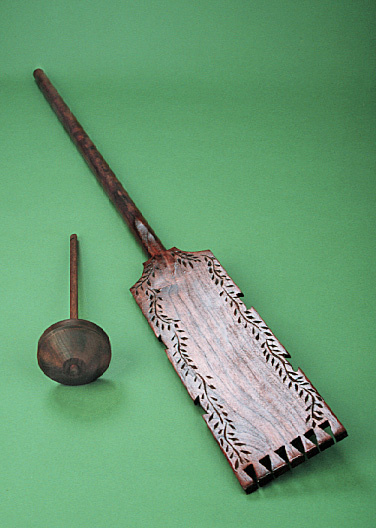
So Wolters solution is that it must be the "plying spindle" or "doubling spindle", which was larger and grasped by two hands. It is best made today with a dowel and two CD's. It is a slightly different instrument from the spindle, and is used to combine two or three fine threads into heavier twisted yarn. The plying spindle either has one large whorl or two whorls in order to hold the thicker weight of the yarn.

There are several points that can be noted from this study.

The first is that I can't find a modern translation which directly reflects recent scholarship on this word kishor. Wolters published his article on kishor in 1994* . Waltke quotes Wolters' meaning "doubling spindle" in his Proverbs commentary, 2005, which he prepared for the revision of Proverbs in the TNIV, but the TNIV still has "distaff".

Second, no one pays any attention to the entry in the Koehler Baumgartner which, in any case, appears to lack evidence.

Third, Jerome played it safe and went with the abstract.

Fourth, I am not sure how the HCSB decided on their innovation of "spinning staff".

Fifth, the NET Bible passes over this word in silence. It is "distaff" and no note is appended implying that the meaning for this word is near certain, even though it is entirely unknown.

Sixth, I note that Luther's translation, based on his vague impression that women use a distaff although they do not grasp it in their hands, has been overwhelmingly influential. Tradition preserves "distaff" in most current Bible translations. Much can be said for inertia!

On a final note, I'd like to congratulate the winner in this contest, the NLT,
    Her hands are busy spinning thread, her fingers twisting fiber.
Those translators must have read Wolters! I really identify with that translation, as I still have the memory of that feel of the fibres in my fingers from when I learned how to spin at some point in my "earth mother" past. Shhh. Don't tell.

Update: In googling pictures of the distaff I can see that in some traditions the distaff is held in the hand, and is only a stick or rod. What if a distaff was used but we have no record of it? This is one of those cases where we may never know what the word means. But more pretty pictures.

Those of you who are interested in Waltke's approach to authorship in the Hebrew scriptures, should take time to read this review. It fairly represents what Waltke is saying in class.
    The most obvious result of the book’s evangelical orientation is the identification of Solomon as the composer of the contents of Chapters 1-29. Chapter 30 was written by Agur son of Jakeh and all of Chapter 31, including the acrostic poem on “The Valiant Wife,” by Lemuel, who “[s]ince such a king is unattested in Israel’s history . . . is probably a proselyte to Israel’s faith” (2.503). Those who, like this reviewer, have fallen victim to the “endemic scholarly skepticism about the Bible’s own claims of its authorship” (1.27, 2.501) will need to bracket this aspect of the commentary in order to profit by its other aspects. But in fact Waltke’s approach is more nuanced than this statement makes it sound. He concludes, “The final editor, the real author of the book, not of its sayings, probably lived during the Persian period … or in the Hellenistic era” (1.37).
* Hebrew Union College Annual 65. (1994), 91-104.

Labels:

Saturday, July 07, 2007

Song of a Valiant Woman: 5

Drew Kaplan writes about the eshet hayil as a woman of substance. According to Christine Yoder this best captures the qualities of "strength and capacity, wealth and skill". Her article provides a socioeconomic reading of the passage and certainly widens the discussion.

At this point I still prefer the perspective of narrative criticism, which I would have to admit is more familiar to me, but I found that Yoder brought a lot of new insights to the discussion. There is no sense in which the two approaches are mutually exclusive. I also had time to read Waltke's commentary on this chapter. He stands very much in the narrative tradition and accords strongly with Wolters' approach.

Wolters continues,
    Heroic poetry typically describes the exploits of men belonging to an aristocratic class in which honour and individual initiative rank high on the scale of values. The hero is typically a nobleman. So too the valiant woman of Proverbs 31 is clearly a wealthy lady of the upper classes.

    All these traits in the poem give us reason to suppose that the Valiant Woman is deliberately described in terms borrowed from a tradition of heroic poetry.
So Wolters argues that the primary sense of the language of this poem denotes heroic prowess and applies to a class of individuals who would be noble and possess military strength. If the primary understanding is that of class, it is easy to see why the woman would be attributed characteristics belonging equally to the males of her class. The purpose is not to define the wife as distinct from her husband in quality but the same. She is worthy of him because she has the same qualities of strength, honour and wisdom.

This is typical of a class-based society. I would argue that it in a society in which the notion of class is no longer openly acknowledged as a value, the distinction between men and women is thrown into deeper contrast. In a class-based society, royalty must marry royalty and a nobleman seeks to marry a noblewoman.

The way in which this woman is distinct from her husband is that she generates the economic base for the family and creates wealth to support her husband who sits in the gates. In this sense she could be considered a woman of substance. However, I would argue that hayil refers to the quality which makes her equal to and the same as her husband. They are both hayil, or noble in quality, of the warrior class.

So, although this woman is indeed a woman of substance, I would hesitate to use that as the primary translation for hayil. She generates wealth because she is hayil, rather than the other way around. She not only provides for her family but she assists the poor and needy, and wisdom and the law of lovingkindness are on her tongue.

Certainly, hayil may mean strength, courage, nobility, wealth, wisdom, even academic accomplishments in different societies - whatever is most valued as capital at the time. The most basic meaning of hayil might actually be virtue, not in the sense of chastity but in the sense of excellence or arete in Greek. However, if one defines the poem as heroic, which it seems to be from the use of the vocabulary of aggression found in the poem, then the primary sense of this word would be 'heroic', 'noble'or 'valiant'.

Labels:

Wednesday, July 04, 2007

Song of a Valiant Woman: 4

Wolters has proposed that the hymnic form is not necessarily associated only with praise of God or temple liturgy. He then goes on to look at the Song of the Valiant Woman in relation to heroic poetry. He compares this poetry to the oral epics of the Homeric, Norse and Yugoslavian tradition.

Although Wolters does not state this explicitly, his mention of these other cultural traditions ties his argument into the thinking of Walter Ong, and Milman Parry on oral epic poetry. Wolters skillfully demonstrates how this understanding of the passage illuminates some of the more obscure vocabulary and casts it in a different light.

In my last post I showed how this approach is coherent with the retranslation of verse 31 using "honour her" or "extol her for the fruit of her hands" instead of "give her of the fruit of her hands".

In the following excerpt Wolters runs down the passage and demonstrates that there is a recurring use of a certain type of language that is not evident in English. He writes (page. 10),
    Against this background it is striking to that the Song of the Valiant Woman displays a number of features which are clearly reminiscent of poetry of the heroic type. I list the following items.

    1. The subject of the song is called an eshet hayil, a term which has been translated in many different ways, but which in this context should probably be understood as the female counterpart of the gibbur hayil, the title given to the 'mighty men of valour' which are often named in David's age. The person who is celebrated in this song is a 'mighty woman of valour'.

    2. That this is the meaning intended emerges also from the recurring of the word hayil in verse 29 near the end of the song, forming a kind of inclusio with eshet hayil at the beginning. There it occurs in the idiom asa hayil, which regularly means 'to do valiantly' in a military context.

    3. Besides these two occurances of hayil, a word meaning basically 'power' or 'prowess', it is remarkable how often the woman's strength is mentioned in the song. 'She girds her loins with strength'(v.17) and 'she is clothed with strength and honour'(v. 25), where the Hebrew word is oz in both cases. The second line of verse 17 adds 'She strengthens her arms' (immets).

    4. A number of words and phrases besides asa hayil seem to have a specifically military connotation. In the expression 'you surpass them all' (v. 29) the phrase ala al is often used elsewhere in the sense of going out to do battle against an enemy. (In fact, the meaning 'surpass' is assigned to it only here. See BDB and KB. s.v. ala. In verse 19 apparently innocent words 'she stretches out her hands to the distaff' translate the idiom shalah yad be, which (as Paul Hambert has pointed out) always has an aggressive connotation elsewhere, so that its use in this peaceful context is exceptional. It is remarkable, moreover, that the same expression (with the preposition le) is used in the heroic context of the Song of Deborah to describe Jael's grasping of the tent peg with which she kills Sisera (Judges 5:26) I might mention also the use of the warlike words shalal, 'plunder' (v.11) and terep, 'prey' (v. 13) in the unusual derived sense of 'profit' and 'food' respectively.
Wolters then reprises the discussion of tanu, showing how it is used to mean 'celebrate in song' and appears elsewhere only in the context of other heroic poetry, the song for Jephthah's daughter and the Song of Deborah. Wolters relates these short praise poems to panegyric odes. [my link].

For those who are counting, this is not a gender post, but an interest on my part in retrieving a few words of Hebrew vocabulary to my memory as well as relating issues of biblical interpretation to my previous training with the Toronto School of Communication. (most of which I have forgotten!)

Labels:

Song of a Valiant Woman: 3

Wolters continues with his exploration of Prov. 31:10-31 as a hymn. He writes,
    Afterall there is no good reason to restrict the term 'hymn' to songs in praise of God. Historically, at least, the Greek hymnos, applied to poetry 'in praise of gods or heroes', and a similar point can be made with respect to the Hebrew tehilla [praise - the Psalter is called the Book of Tehilla] and its cognates. Neither the sapiential features nor the human subject should prevent us from reading the Song of the Valiant Woman as illustrating the Gattung [genre] which Gunkel [1967] gave the technical designation Hymnus.

    There is first of all the overall structure of the hymn. This is generally divided into the introduction, which announces the praise which will be given and names its subject, then the body or Haupstück, which enumerates the praiseworthy attributes and deeds of the mighty one being acclaimed, and thirdly the concluding exhortation to the audience and others to join in the poet's praise. In the acrostic poem of Proverbs this corresponds respectively to verses 10-12, in which the subject of praise is intorduced as the Valiant Woman, a priceless asset to her husband; to verses 13-27, in which are recounted the mighty deeds of the woman as efficient manager, enterprising businesswoman and generous benefactress, and then the audience and her own handiwork are exhorted to join in praise. To appreciate the last point, we must realize that the imperative tenu, with which the last verse begins, is addressed to the audience (since the imperative is plural), and that it is to be read as a form of the verb tana, 'celebrate in song', not of natan, 'give'. The song therefore concludes with the words,

      Extol her for the fruit of her hands,
      And let her works praise her in the gates.

    Given this concluding call to praise, the overall structural parallel with the hymns of the Psalter is striking. (Wolters. page 6)
Wolters goes on to outline in detail the parallels with hymns of praise. He compares the products of the valiant woman, those things which praise her, to the animate and inanimate creatures which praise their maker in heaven. He notes the participial form of the verb tsopiyya in verse 27 and dignity or honour in verse 25. He ends by commenting on the use of 'surpass' in verse 29 and concludes that this passage is a hymn.

There is some fascinating material in this book so I hope you will follow along. I have deliberately chosen the JPS 1917 as a very literal version because I feel that it best represents some of the elements that Wolters comments on. However, he proposes many changes that are not found in the JPS.

For example, he proposes the following change for verse 31.
    Extol her for the fruit of her hands,
    And let her works praise her in the gates. Wolters

    Give her of the fruit of her hands;
    and let her works praise her in the gates. JPS 1917.
The TNIV is one of the few translations that accords with this.
    Honor her for all that her hands have done,
    and let her works bring her praise at the city gate.

Labels:

Tuesday, July 03, 2007

Song of a Valiant Woman: 2

Wolters opens with a discussion of the form of Prov. 31: 10-31. It is a perfect alphabetic acrostic, one which takes the form of a hymn of praise. He shows how a wisdom psalm and a hymn are not that different in form and suggests that it is false to differentiate between a text which is in praise of God and one in praise of a human.

He holds up for comparison Psalm 111, considered a hymn in praise of God, and its twin Psalm 112, a wisdom Psalm in praise of a righteous man. He then shows how Proverbs 31:10 - 31 in praise of a valiant woman is a mirror image of Ps. 112. Here are the three passages from the JPS 1917.

Prov. 31:10-31. A hymn of praise for the women who fears the Lord.
    10 A woman of valour who can find? for her price is far above rubies
    11 The heart of her husband doth safely trust in her, and he hath no lack of gain.
    12 She doeth him good and not evil all the days of her life.
    13 She seeketh wool and flax, and worketh willingly with her hands.
    14 She is like the merchant-ships; she bringeth her food from afar.
    15 She riseth also while it is yet night, and giveth food to her household, and a portion to her maidens.
    16 She considereth a field, and buyeth it; with the fruit of her hands she planteth a vineyard
    17 She girdeth her loins with strength, and maketh strong her arms.
    18 She perceiveth that her merchandise is good; her lamp goeth not out by night.
    19 She layeth her hands to the distaff, and her hands hold the spindle.
    20 She stretcheth out her hand to the poor; yea, she reacheth forth her hands to the needy.
    21 She is not afraid of the snow for her household; for all her household are clothed with scarlet.
    22 She maketh for herself coverlets; her clothing is fine linen and purple.
    23 Her husband is known in the gates, when he sitteth among the elders of the land.
    24 She maketh linen garments and selleth them; and delivereth girdles unto the merchant.
    25 Strength and dignity are her clothing; and she laugheth at the time to come.
    26 She openeth her mouth with wisdom; and the law of kindness is on her tongue.
    27 She looketh well to the ways of her household, and eateth not the bread of idleness.
    28 Her children rise up, and call her blessed; her husband also, and he praiseth her:
    29 'Many daughters have done valiantly, but thou excellest them all.'
    30 Grace is deceitful, and beauty is vain; but a woman that feareth the LORD, she shall be praised.
    31 Give her of the fruit of her hands; and let her works praise her in the gates.
Psalm 112. A Wisdom psalm or hymn of praise for the man who fears the Lord.
    1 Hallelujah.
    Happy is the man that feareth the LORD, that delighteth greatly in His commandments.
    2 His seed shall be mighty upon earth; the generation of the upright shall be blessed.
    3 Wealth and riches are in his house; and his merit endureth for ever.
    4 Unto the upright He shineth as a light in the darkness, gracious, and full of compassion, and righteous.
    5 Well is it with the man that dealeth graciously and lendeth, that ordereth his affairs rightfully.
    6 For he shall never be moved; the righteous shall be had in everlasting remembrance.
    7 He shall not be afraid of evil tidings; his heart is stedfast, trusting in the LORD.
    8 His heart is established, he shall not be afraid, until he gaze upon his adversaries.
    9 He hath scattered abroad, he hath given to the needy; his righteousness endureth for ever;
    his horn shall be exalted in honour.
    10 The wicked shall see it, and be vexed; he shall gnash with his teeth, and melt away;
    the desire of the wicked shall perish.
Psalm 111. A hymn of praise of the Lord.
    1 Hallelujah.
    I will give thanks unto the LORD with my whole heart, in the council of the upright, and in the congregation.
    2 The works of the LORD are great, sought out of all them that have delight therein.
    3 His work is glory and majesty; and His righteousness endureth for ever.
    4 He hath made a memorial for His wonderful works; the LORD is gracious and full of compassion.
    5 He hath given food unto them that fear Him; He will ever be mindful of His covenant.
    6 He hath declared to His people the power of His works, in giving them the heritage of the nations.
    7 The works of His hands are truth and justice; all His precepts are sure.
    8 They are established for ever and ever, they are done in truth and uprightness.
    9 He hath sent redemption unto His people; He hath commanded His covenant for ever;
    Holy and awful is His name.
    10 The fear of the LORD is the beginning of wisdom; a good understanding have all they that do thereafter;
    His praise endureth for ever
Wolters points out the many parallels, including strength, wealth, compassion and liberality to the poor and a fearless attitude. There is also a concluding antithesis between the righteous and the wicked for the man, and between between deceptive beauty and fear of the Lord for the woman. The similarities are striking.

Labels:

Monday, July 02, 2007

Song of a Valiant Woman: 1

By serendipity I have just found and purchased The Song of a Valiant Woman: Studies in the Interpretation of Proverbs 31:10-31, by Al Wolter. The brief review for this book says,
    This superb academic text examines in detail the history of the interpretation of the woman in Proverbs 31. It also provides ground breaking form critical, philological and Christian worldview studies on the 'Valiant Woman'.
It is an extremely far-ranging book encompassing trends in biblical interpretation over 2000 years. It is neither a feminist treatise nor a simplistic study on how to be a good wife - although there must be some of that. It includes the study of this song as a hymn and heroic poem; it covers interpretation from the Patristics, rabbis, the Puritans and more. The "woman" is understood allegorically as a wife, the church, the Torah, Wisdom or the soul. It is just the sort of grounded historical treatment which should interest everyone. I am going to blog excerpts from this book over the next few weeks.

The subject is once again germaine to our concerns regarding how to translate Ephesians 5. As an introduction I would like to quote a feminist response to this song and an unusual Puritan response.

Denise Charmody, 1989, writes,
    In a single text, then we find the ambiguity of the heritage bequeathed women by the Hebrew Bible. Even at its moment of high praise, the Bible reflects a man's world. From the Eve created as the helpmate of Adam to the good wife who eases the life of her senatorial husband, woman is the second sex. This patriarchal view is simply not acceptable. (Wolter, page 141)
However, here is how Wolter describes the interpretation by the Puritan theologian Thomas Cartwright (1535-1603),
    A point which distinguishes Cartwright's treatment of the Song from that of most others is his concern to apply it to men as well as women. ... After commenting in connection with verse 11, that the Valiant Woman should take care never to appear unchaste, Cartwright adds: 'This same point is also to be applied to the duty of the husband toward the wife.' Or again, after stating in connection with verse 12 that the wife should do good to the husband whatever his age, health or wealth, Cartwright adds 'These things must be performed also by the husband for the wife.' (Wolter, page 123)
Here is the irony, that a feminist would reject the text because the wife is seen as the auxiliary of the husband, but a Puritan finds reciprocity and mutuality of relations in this passage. The role of women in the narratives and songs of the Hebrew scriptures may be seen as that of a valiant and benevolent reciprocal partner, rather than as person under authority and a net beneficiary of male strength.

Labels: