Better Bibles Blog has moved. Read our last post, below, and then
click here if you are not redirected to our new location within 60 seconds.
Please Bookmark our new location and update blogrolls.

Sunday, April 08, 2007

Lindisfarne Gospels: 12

a poetic reconstruction of luke 23:54 - luke 24:6
in the old english gloss

and the day was preparation
and the sun day lightened
and the wives following
came from galilee with him
saw the burial place
and how positioned was his human likeness
and coming back
they readied the herbs/sweet stench and ointment

and sun day they were
silent
according to the commandment

first of sun day in early dawn
they came to the burial place
carrying the sweet stench they had readied
and found the stone
rolled back from the burial place
and entering did not find
the human likeness of lord healer

and it happened
that their thoughts were confused
that behold there were two men
standing by/near them in shining clothes
and they were endreaded
and bent their outlook to the earth

and they said to them

why do you seek the living with the dead
is not here but arisen

remember how spoken it was to you
while you were still in galilee

Labels:

Friday, April 06, 2007

Lindisfarne Gospels: 11

Another nomen sacrum found in the Lindisfarne Gospels is "ihu" for Jesus. In Greek manuscripts the name Jesus ΙΗΣΟΥΣ (iota, eta, sigma, omicron, upsilon, sigma) became ΙΣ, ΙΥ, ΙΗΣ, or ΙΗΥ, and this became what you see in the image on the left in miniscule, lower case - "ihu". These are the first three letters of Jesus' name in Greek in the genitive case, meaning "of Jesus."

In the form of IHS, this was read in Latin as an acronym, Iesus Hominem Salvator - Jesus, saviour of mankind. However, in the Lindisfarne Gospels "ihu" was glossed simply as haeland, saviour or healer. Throughout these gospels Jesus' name is always written as haeland.

So it appears that in the Lindisfarne Gospels, Jesus' name has recovered its original meaning of 'salvation.'

    And she shall bring forth a son, and thou shalt call his name JESUS: for he shall save his people from their sins. Matt. 1:21
I can't tell whether this came about as a misreading of the Greek/Latin letters IHS or as a conscious understanding of the meaning of Jesus' name. Haeland in Old English is often translated into modern English as Healer. Now I can go back and reread the Dream of the Rood, with a new understanding. When it says,
    But lying there long while, I,
    troubled, beheld the Healer's tree,
I can also understand that it is roughly equivalent to the modern English,
    But lying there a long while, I,
    troubled, beheld Jesus' cross
The texts of Old English had once seemed curiously void of Jesus' name, but now when I read the word "Healer", I recognize it.

Appendices:

Further note on the papyri.

In the earliest manuscripts a lunate 's' was used, so the earliest nomen sacrum in the papyri for Jesus was IC or IHC. Joshua's name appeared identically in the Septuagint so the copyists seem to have thought of them as the same name.

The first image is from a third century MS 2648, Joshua in the Septuagint, on this page; and the second one, Jesus, is from John's gospel, P66 from here.


Full page image of Matt. 1:1 in the Lindisfarne Gospel (Right click and open in new window. Then read with the glosses below)
English - The book of the generation of Jesus Christ, the son of David, the son of Abraham
Old English gloss - bóc cneoreso haelandes cristes davides sunu abrahames sunu
Latin - liber generationis Iesu Christi filii David filii Abraham ("ihu xpi" for Jesus Christ)
Greek - ΒΙΒΛΟΣ ΓΕΝΕΣΕΩΣ ΙΗΣΟΥ ΧΡΙΣΤΟΥ ΥΙΟΥ ΔΑΒΙΔ ΥΙΟΥ ΑΒΡΑΑΜ (spaces added)

Enjoy!

Bibliography
Further note:
In the last century "Heiland" was a name taken by Hitler so this way of translating savior in the German Bible became highly problematic.

Labels:

Wednesday, April 04, 2007

Lindisfarne Gospels: 10

The Lindisfarne gospels have a great variety of abbreviations throughout both in Latin and in Old English. The ones that I noticed right away were those called the nomina sacra. In this kind of abbreviation either the first and last letter of the word are written, or sometimes 3 letters, while a line suspended above indicates that letters are left out.

They are generally called nomina sacra if they are one of the words on a list of 15 or so words that have been so abbreviated in the earliest Greek manuscripts only for their sacred use but not for the profane use. I have paraphrased the explanation from this page. Nomina Sacra in P46

Nomina sacra are special abbreviations which appear in Christian texts. Unlike most abbreviations, which are supposedly intended to save time (see Abbreviations in P46), nomina sacra are used to set certain holy words apart from the rest of the text. This is inferred from the fact that these words are abbreviated in their sacral usages but not in profane usages (e.g. ὑΐοϲ, 'son' is contracted to υϲ when it refers to Jesus, the Son of God, but the same word is not contracted in other usages).

There are two major lines of thinking about the origin of the nomina sacra. Either the abbreviation began as a utilitarian aid to easy writing and recognition of frequently repeated significant words; or a specific list of words were abbreviated in their sacred use, as special treatment.

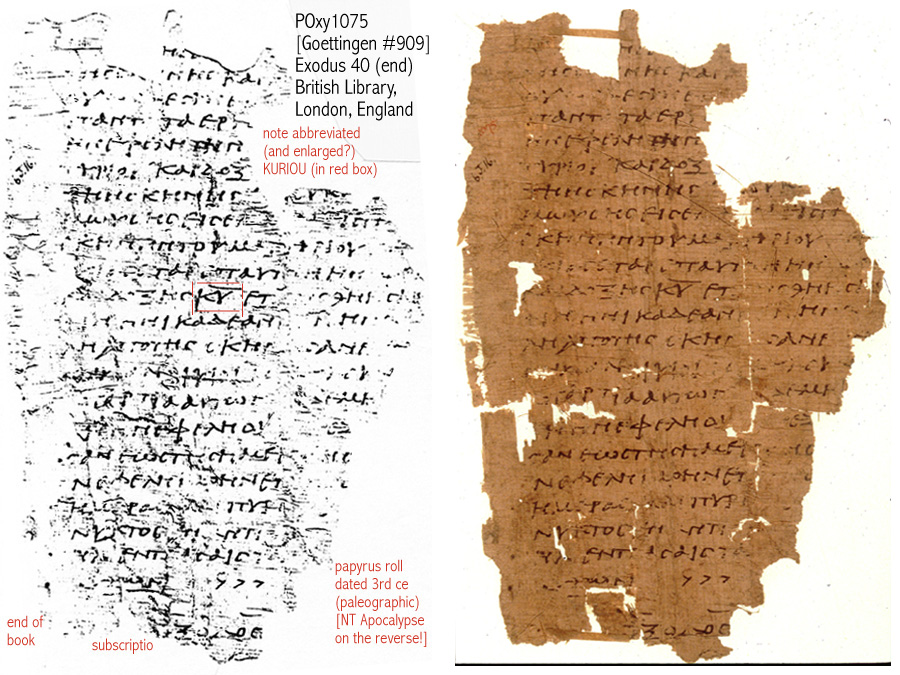
The abbreviation KS for Kurios* (not pictured) is also found in the Septuagint.The question arises as to whether the development of the nomina sacra was in some way related to the use of the tetragrammaton in Hebrew. In each case the name of the Lord is, in some sense, dephoneticized. The written string of letters no longer represents a pronounceable string of sounds. I simply cannot comment any further on this at the moment, except to say that it is an extremely interesting line of investigation in the field of early manuscripts.

Naturally, in Greek and Latin, because of case endings, the last letter in the name will indicate the case, so the nomina sacra does not possess an immutable shape. In Latin Deus is either DS, DI, DM, and DO, for example. Dominus is DNS, DNI, etc. and Christus is XP, XPS, XPI, etc. with Greek letters later mixed into the Latin. So there was a weakened relationship with the phonetic values of letters and a stronger relationship with a constant visual relationship across languages, yet still representing the case endings.

I have found so far that further research into the nomina sacra has given me a lot to think about concerning how individuals and religious communities regard the name of God. People approach the name of God with reverence and accord it greater recognition and visibility while distancing it from the phonetic system.


Believers are drawn to a symbol for God, then Jesus, and later the saints, which crosses boundaries of time and space. But the old connections are sometimes forgotten and new ones need to be forged. Reading about the nomina sacra has inspired me to do further reading in how the name of God is represented in the Hebrew scriptures.

I will post soon on the nomen sacrum for the name of Jesus in the Lindisfarne gospels.

*I have not shown the KS nomen sacrum for Kurios, Lord, in this post but it can be found here in Ex. 40, 3rd century and is recorded on this webpage. (In actual fact, it is a KU in this image but it is called the KS)

Labels:

Sunday, March 25, 2007

Lindisfarne 9

Eadfrid, bishop of the Lindisfarne church, (was) he (who) at the first wrote this book in honour of God and St Cuthbert, and all the saints in common that are in the island. And Edilwald, bishop of the people of the Lindisfarne island made it firm on the outside, and covered it as well as he could.

And Billfrid, the anchorite, he wrought in smith's work the ornaments that are on the outside and adorned it with gold, and also with gems, overlaid with silver, unalloyed metal.

And Aldred, an unworthy and most miserable priest, with the help of God, and St. Cuthbert, glossed it above in English and made himself at home with the three parts. Matthew's part, for the honour of God, and St. Cuthbert. Mark's part for the bishop. And Luke's part for the brotherhood, together with eight oras of silver for admission.

And St. John's part for himself, together with four oras of silver, (deposited) with God and St. Cuthbert; to the end that he may gain admittance into heaven, through God's mercy, and on earth happiness and peace, promotion and dignity, wisdom and prudence, through St. Cuthbert's merits.

Eadfrid, Oediluad, Billfrid, and Aldred made and adorned this gospel book in honour of God and St. Cuthbert.

Above is the colophon found at the end of the Lindisfarne Gospels. It is a text written in Old English at the end of the 10th century. Here we see a text composed in English which has the significant feature of beginning each major section after the introduction with 'and'.

Surely we are looking at the influence of the Hebrew vav translated into Greek as kai, into Latin as et, represented then by the Latin ampersand & (et), then the Tironian shorthand 7 (et) and finally the English 'and'.

There are also several Greek ampersands but they have a separate history. It is an equally interesting one since two different Greek ampersands appear together in the printed Textus Receptus of Erasmus.

I wonder if anyone has yet written a book on the short history of 'and'. Hmm. Nice thought!

Labels:

Sunday, March 11, 2007

Lindisfarne Gospels 8

It is time to get back to the Lindisfarne gospels. Rather than making progress I am going to digress. There is really only one way to approach new material, and that is to be prepared to go back and check every, absolutely every, tweek and and twitch. I don't do it often enough, but I am in no hurry for this series to end.

In the appreciation of an object of art, one often finds not only beauty but complexity and humour. That is what I see here. The monks of Lindisfarne brought the word to life in more ways than one.

I have fallen into a stupor contemplating the letter M. Here is a perfect example of glyph variants. All these different shapes are M. They rotate and connect in different ways, but they are all M.

If you had no idea of the meaning of the text you were looking at you would not know at first that these were all M. So how do people learn to read manuscripts? Only by noticing each detail, and making connections. Over and over.

If we always approach a text that we are already familiar with in English, we have little chance of experiencing what it meant to be one of the first scribes or translators. But those who work in previously unwritten languages, or with previously undeciphered texts, know that it is something else entirely to simply start at the point of observation and build slowly.

It requires, I think being lost in the pursuit of a seemingly meaningless task. To be satisfied on one level to accept lack of meaning. To approach something with observation alone. And this is why one has to love what one does for its own sake.

It is not enough to always want to argue the point. Some days there is no point to argue. Just enjoy.

--

And other days, well, sure enough, there is indeed a point to argue. How about these little things? One is a rho cross, one a cross, and one is the sign for vel 'or' in Latin. You don't want to get them confused. These have a similar shape but a distinct semantic value. Enough blah, blah for tonight.
Fortunately I do have the full text of the Lindisfarne gospels sent by a reader. And here is a quote from an article by R. W. Southern which I have also been sent by a reader. Thank you. I have read at least one book by Southern and I would highly recommend his writing about the medieval period. Here is what he says.

    The Jarrow books are sober and unadorned ... The Lindisfarne book, on the other hand, is an extravagant artistic masterpiece, in which the forms of Irish imagination are adapted to a somewhat more restrained, but still luxuriant pattern of visual images.
Noda and Suspensions - useful link for Irish/OE ligatures

Labels:

Monday, March 05, 2007

Lindsfarne Gospels 7

And his fame went
throughout all Syria:
And they brought unto him
all sick people that were
taken with divers diseases
and torments,
And those which were
possessed with devils,
and those which were
lunatick, and
those that had the palsy;
and he healed them.
And there followed him
great multitudes of people
from Galilee,
and from Decapolis,
and from Jerusalem,
and from Judaea,
and from beyond Jordan.
Matt. 4:24-25 KJV

This is a comparison of the Latin Vulgate and the KJV. Look at how the ampersand has been placed at the beginning of several lines. The ampersand, which is still at this point a fairly transparent 'et' ligature, is attached onto the word which it precedes, as are the prepositions. This is about as close as I can get to the manuscript using the KJV. Here is the same passage in the TNIV.

    News about him spread all over Syria, and people brought to him all who were ill with various diseases, those suffering severe pain, the demon-possessed, those having seizures, and the paralyzed; and he healed them. 25 Large crowds from Galilee, the Decapolis, Jerusalem, Judea and the region across the Jordan followed him.

Greek manuscripts do not usually space words in a line strategically; they usually just run on from one line to the next without much spacing. However, there are paragraph breaks and some organization of larger units. But I wonder if the visual organization of the text in the Lindisfarne manuscript might give us some idea of how the scribes perceived the passages they were writing.

Once again I don't want to read too much into this. However, I will show you one more example.

And, lo, the angel of the Lord
came upon them,
And the glory of the Lord
shone round
about them:
and they were sore afraid.
And the angel said unto them,
Fear not

PS The spacing is not going to come out right in blogger, I can't predict the length of a line so I will have to fool around with this a bit. I think that I am going to be reasonably happy with this draft. I have wanted to know how to represent poetry better in blogger for some time. Here goes.

Labels:

Sunday, March 04, 2007

Lindisfarne Gospels 6

There has been some discussion as to whether this symbol to the left of the name is a chi rho. It has been so identified in this lecture.

And on these two coins both symbols are identified as a chi rho here. I am not sure that it is in any way important that this symbol be identified but it is convenient to give it a name. I understand it to be a vertical chi rho but I have also seen it called a 'rho cross' elsewhere.

I hope to write more about the ampersand next.

Labels:

Saturday, March 03, 2007

Lindisfarne Gospels 5

Since the ampersand is a significant symbol in the Lindisfarne Gospels, both in its Latin form and in its Celtic form, it is worth illustrating some of the various shapes this symbol can take.

These shapes are all the Latin ampersand represented in a variety of contemporary fonts. This character originally developed from the 'et' ligature, in which 'e' and 't' were written together as one These different glyphs are all attributed to the codepoint for the ampersand. Notice how the ampersand merges eventually into the cross shape.

The cross shape, as a plus sign, is now firmly associated with the ampersand in the popular consciousness. It appears alongside initials carved in a tree to represent love and romance.

In this poster the cross sign does double duty representing both death and sacrifice and romantic union, all at once. The wording reads, 'hope and despair', 'tragedy and love', 'Romeo and Juliet'.

The ampersand represents parataxis and not hypotaxis; romantic union is the antithesis of subordination. There is no hierarchy in the ampersand. Two are joined beside each other as equals.

These two symbols, the cross and the ampersand feature as important elements in the manuscript of the Lindisfarne Gospels. The ampersand, appearing in the Latin text, is the abbreviation for 'et' and in the Old English text it is the Tironian et sign.


Here are three distinctive shapes of the Tironian et sign. This sign is part of a shorthand system supposedly developed by Tiro, a slave and clerk of Cicero, called Tironian Notes. It found its way into the repertoire of scribes throughout Europe. (Incidentally my German hasn't improved all that much since I wrote that post but it is still true that you can only read in depth about ancient shorthand in German. English is not the repository of all knowledge - yet!)

And finally here are the two ampersands and the cross as they appear in the Lindisfarne Gospels. In my next post I will illustrate how the Latin ampersand is featured in the manuscript.

PS Manuscript copiers must have had at their disposal a certain amount of red ink. Red ink is a common feature in manuscripts from at least the 7th century to the 15th century. Not that I like a red letter Bible - I don't - but sometimes it is worth knowing when an element can be attributed to medieval practise as well as modernity.


Labels:

Lindisfarne Gospels 4

This is the second initial page for Matthew and begins the narrative of Christ's birth. It is the beautiful Chi Rho page.

The chi rho symbol has many forms based on anything from this asymmetric sweeping chi to the simple upright cross seen in the previous post. The chi itself has a history much longer than its name - chi.

The letter chi has the same shape as one form of the letter taw in the old Hebrew (Phoenician) script. As the letter tau, it was simply a 'mark' or a brand, the seal of the Hebrew scriptures and the anointing mark or crismon of the early Christian church. As either + or x it has endured as one of the oldest multivalent symbols of civilization.


The greatest danger is that we will read into this mark, x or +, either too little or too much. Here is the verse "And Simon Peter answered and said, Thou art the Christ, the Son of the living God." Matt. 16:16 in Canadian Syllabics.

People viewing the word xmas, which also contains this representation of Christ might feel that they are looking at something which belittles Christ instead of realizing that this symbol represents a continuity of representation over 2000 years old.


On the other hand, one might read into the symbol a meaning which was never intended. There has been some discussion around this mark in the margin of the Dead Sea Scrolls, beside Isaiah 41:8 - 11.

Does it have some religious significance or is it just a mark? Sometimes one has to be willing to accept that this mark can mean either Christ, or consecration, or a signature, or the wrong answer, or a ballot vote, or a kiss, or anointing, or branding, or the mathematical symbols of x or +, - or just a mark. It can be the sign of dedication, of possession, of affection, of illiteracy, of fulfillment, or of sacrifice.

In translation it is sometimes a judgement call as to when information is incidental and when it is meaningful. Communication is sadly imperfect in this life; it is a system of representation, nothing less and nothing more. It is not meaning itself. In the words of Paul,

    For now we see through a glass, darkly; but then face to face: now I know in part; but then shall I know even as also I am known. 1 Cor. 13:12.

The scribe of the Lindisfarne Gospels was thought to be so aware of our human imperfection that he left parts of the manuscript unfinished, perhaps to represent this aspect of our humanity - our inability to create perfect representation, perhaps it was modesty. Look again at the unfinished and unpainted letters below the Chi Rho in the Lindisfarne image at the top of the page.

Here is the symbol in Unicode, first as the khi ro and then as the tau ro, both in the Coptic range. The chi rho also exists.


Addendum: In Coptic the chi ro and the tau ro occur as distinct and separate ligatures. However, in Old English manuscripts this symbol has been identified as a chi rho by Michelle Brown. I apologize if I gave the wrong impression.

Labels:

Thursday, March 01, 2007

Lindisfarne Gospels: Index

Lindisfarne Gospels 1 - Introduction
Lindisfarne Gospels 2 - foreign and curious elements in the Latin script
Lindisfarne Gospels 3 - Introducing the Chi Rho and the Tironian et sign
Lindisfarne Gospels 4 - Chi Rho
Lindisfarne Gospels 5 - ampersand
Lindisfarne Gospels 6 - chi rho again
Lindisfarne Gospels 7 - ampersand in Matt. 4:24-25 and Luke 2
Lindisfarne Gospels 8 - variations on the letter M
Lindisfarne Gospels 9 - paratactic "and" through the millenia

Bibliography

Backhouse, Janet. The Lindisfarne Gospels
Brown, Michelle. Lectures
Insular Miniscule
Irish Ligatures
Notae and Suspensions
Old English Alphabet
Skeat, W. The Gospel According to Saint Luke in Anglo-Saxon and Northumbrian Versions

Labels:

Lindisfarne 3

Here are some details taken from the initial pages of the Lindisfarne gospels.


This first one says "Jesus Christ, Matthew man." The pictorial symbol for each gospel is named along with the gospel writer. Preceding the text is the vertical cross form of the Chi Rho symbol.


For Luke the pictorial symbol is the calf and here the title is preceded with the Chi Rho symbol and followed by this distinctive form of ampersand which resembles the number 7.

For John the pictorial symbol is the eagle and this time the distinctive characteristic of the rho is almost lost and the symbol now resembles the simpler 'Crist cross'.


While I do not know the earliest instance of the ampersand following a title or list, this pattern was enduring and in children's hornbooks, used for learning letters, the alphabet was preceded by the 'criss-cross' and followed by the 'ampersand'. Children would recite the alphabet as 'criss-cross, a per se a, be per se be, .... and per se and'. Eventually the 'and per se and' became called the 'ampersand' . It was sometimes considered to be the 27th letter.

The chi rho and this alternate ampersand (acually called the Tironian et sign, which I will explain) played important roles in the Lindisfarne gospels so I will write about them at greater length.

Addendum: Since my interpretation of the symbol preceding the name of the gospel writers has been questioned, I will quote here from Michelle Brown,


    If you then look in the lettering itself you can find at the very top left written in letters of gold, a chi-rho, the symbol of Christ, the first two letters of Christ in Greek and then the words lucas and vitulus, the calf, again symbolising the fact that the evangelist and his gospel are representatives of Christ and actually symbolise part of Christ's ministry.
Michelle P. Brown is curator of illuminated manuscripts at the British Library. She has lectured internationally, has taught for the University of London on history, art history and palaeography and is a co-founder of the Research Centre for Illuminated Manuscript Studies at the Courtauld Institute.

She is a member of the Comité International de Paléographie Latine, a fellow of the Society of Antiquaries, of the Courtauld Institute and of the Institute of English Studies of the University of London, and she is an honorary fellow of the SSI and CLAS. She is a series editor of British Library Studies in Medieval Culture.

Her publications include A Guide to Western Historical Scripts, from Antiquity to 1600, Anglo-Saxon Manuscripts, Understanding Illuminated Manuscripts, The British Library Guide to Writing and Scripts, The British Library Historical Source-Book for Scribes and The Book of Cerne: Prayer, Patronage and Power in Ninth-Century England.

The Lindisfarne Gospels. Fathom.

Labels:

Wednesday, February 28, 2007

Lindisfarne Gospels 2

Let me state clearly that this series is done from the perspective of an amateur. My Junia series was composed in the same spirit.

I will leave issues of Anglo-Saxon script and font for a bit and continue with a few of the more decorative features of the Latin text. However, those interested in the Anglo-Saxon glosses should view the text of John's and Luke's gospels which Anonymous contributed in the comment zone of the previous post.

In looking at the illuminated pages I was immediately delighted to note that letters were not always represented in linear fashion but occasionally in a blocked arrangment. How funky is that? I am all for non-linear where possible.

This image, taken from the initial page of Matthew's gospel, is my favourite. It says "Chri(sti) filii David philii Abraham."

Actually I have no idea why the Greek letter phi appears for the second 'filii' - any ideas? Of course, Christ's name is written with a chi throughout but using the Greek chi symbol for Christ within a Latin text is a typical feature of a medieval manuscript. I will provide illustations for more of the nomina sacra in a later post.

Here are a couple of other examples that demonstrate the fanciful nature of the script. The second image says "quidem multi conati sunt ordina..."

And in the last image, the 's' at the beginning of the second line mimics the shape of the chi at the beginning of the preceding line. This says "Chri(sti) fili(i) d(e)i sicut scribtum est..." This is significant because throughout the manuscript the initial letter of a line is used to advantage to create rhythm and shape on every page.
Now if you look carefully at the 'm' in the second line, it resembles three vertical bars tied by a crossbar. Possibly the letter at the end of the first line in the second image is this same letter turned on its side.

Addendum: Regarding the Greek phi and the fanciful 'm', I found this comment on the British Library site.
"The distinctive display script takes elements from many different cultures. There are Roman capitals, Greek characters and angular letters recalling Germanic runes."


Labels:

Tuesday, February 27, 2007

Lindisfarne Gospels 1

This post is dedicated to beauty and 'exceptional exuberance'. It is also about the first vernacular version of the gospels in English. (This is to give Wayne the heads up that there is a tie-in to translation.) The 'beauty' and 'exuberance' is to communicate happiness to the dear reader. Fortunately I can spin this one out even longer than Junia, so be prepared for a series of visual delight.

This image is from the Lindisfarne Gospels In the British Library. (Right click on the image and open in its own window to view along with this post.) The commentary on this page notes that it is "of quite exceptional exuberance and complexity, offering all the different elements of Eadfrith's decorative vocabulary within a single final tour de force."

A few pages of this manuscript can be viewed at the British Library online gallery* where it is accompanied by this explanation.


    The Lindisfarne Gospels, one of the most magnificent manuscripts of the early Middle Ages, was written and decorated at the end of the 7th century by the monk Eadfrith, who became Bishop of Lindisfarne in 698 and died in 721. Its original leather binding, long since lost, was made by Ethelwald, who succeeded Eadfrith as bishop, and was decorated with jewels and precious metals later in the 8th century by Billfrith the Anchorite. The Latin text of the Gospels is translated word by word in an Old English gloss, the earliest surviving example of the Gospel text in any form of the English language, it was added between the lines in the mid 10th century by Aldred, Provost of Chester-le-Street. Today the manuscript is once again bound in silver and jewels, in covers made in 1852 at the expense of Edward Maltby, Bishop of Durham. The design is based on motifs drawn from the decoration of the manuscript itself.
This page is from the first verse of John's Gospel and the text is,

    In principio erat Verbum et Verbum erat apud Deum et Deus
    (In the beginning was the word and the word was with God and God)
To make it easier to read, I have broken up the words line by line.

    INPrin/cipio/eratverbum/&verbumerat/apudd(eu)m&d(eu)s
In the upper right hand corner is the yellow inscription 'Johannis aquila' (John eagle.) Below that in red is written 'incipit evangelium secundum Johannis' (begins the gospel according to John.) I will post about the nomina sacra (abbreviations), the symbols preceding and following 'Johannis aquila' and several other features of the script in future posts.

As best as I can see, the interlinear Anglo-Saxon gloss for this page reads as follows,

    in prima fryma vaes uord & uord that is godes sunu vaes mid god fader
Even though this is basically a literal word for word interlinear gloss, one can see already that interpretation is represented. In addition to the interlinear gloss there are also notes in the margin of many pages.

It is also interesting to note that the spelling of the Anglo-Saxon text is not constant. 'Word' is spelled as uord here and word elsewhere in the text.

In the initial letters of this page animal ornament alternates with knotwork, and this is the only page of script in the Lindisfarne gospels in which the face of a human is woven into the lettering.


Notes: *There is a fancy little shockwave pageturner version here with a magnifying glass feature. However, I find the static images far more accessible as the whole page can be viewed full size at one time.

** My Anglo-Saxon is not very good so please feel free to correct my transcription. I cannot find a copy of the Anglo-Saxon text on the internet.

*** I became familiar with the Lindisfarne Gospels through this book by Janet Backhouse which I acquired many years ago. A glance at this book makes me suspect that the colours in the internet pages are not always true.

Labels: