Better Bibles Blog has moved. Read our last post, below, and then
click here if you are not redirected to our new location within 60 seconds.
Please Bookmark our new location and update blogrolls.

Thursday, August 14, 2008

My boss is a Jewish carpenter
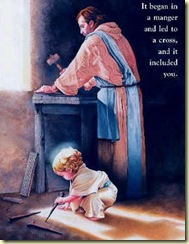
jesus carpenter crossThink about the word carpenter. What does a carpenter do for a living?

What type of carpenter was Jesus?

  1. A house-builder
  2. A furniture maker
  3. A chariot maker
  4. A brick mason

The word for carpenter in the gospels is τέκτων tekton. Our English work architect, meaning “chief builder” is related to this word.

The word occurs twice in the New Testament:

Matthew 13:55 “Isn't this the carpenter's son? Isn't his mother's name Mary? Aren't his brothers James, Joseph, Simon and Judas?”

Mark 6:3 “Isn't this the carpenter? Isn't this Mary's son? Isn't this the brother of James, Joseph, Judas and Simon? Aren't his sisters here with us?" They were not pleased with him at all.”

In these verse the people don’t seem to be complimenting Jesus. My assumption is that they considered Jesus to be an uneducated manual worker and unqualified for a teaching ministry.

jesus joseph carpenter

Jesus was a blue-collar worker. “What does this construction worker think he’s doing?” That captures some of the condescension.

“Carpenter” is a slightly inaccurate translation. Do you agree?

I grew up in Oregon where entire houses are made of wood. They have studs for framing, plywood for underfloor, cabinets, siding and roofing all made of wood. So I grew up imagining Jesus wearing a toolbelt. Maybe with a couple of nails hanging from his lips. But houses were certainly not built that way in ancient times. Wood was scarce. Houses were made out of… what? I assume that the average house in Palestine was far closer in construction to an African hut than an American ranch-style house.

If you’ve only got a fuzzy notion of how houses were built in the time of Christ, you’re in good company. Luke might have been a good doctor but his knowledge of house construction in Galilee was rather weak. In the story of the paralytic let down through the roof, Mark precisely writes, “digging through it.” (2:4) Luke, no doubt imagining the houses of Rome with their tiled roofs writes, “through the tiles.” (5:19)

Can anyone share some online resources that talk about houses and carpenters in the time of Christ?

What kind of τέκτων do you think Jesus was?

See a couple of modern depictions of Jesus as a carpenter: embroidered, wood carving, bumper sticker

Update: Ben Witherington has a Jewish Carpenter poem with the “embroidered” image linked above: A CARPENTER'S CONFESSION.

Labels:

Thursday, August 07, 2008

Do not shoot talk nothing at people that they made bad skin so they must receive heavy.

The title of this post is a back-translation from the the Goiniri Onnele language of Papua New Guinea. The phrase in question is from Luke 6:37, “Do not condemn.” Zephyr at ΑΓΑΠΗΣΕΙΣ is beginning a series of posts discussing his experience checking translations done in Papua New Guinea. What’s so fascinating about his articles is how Papua New Guinean languages are so different from Greek and require different strategies for communicating information. For example, Onnele verbs lack a true passive, require an object, and more which makes it impossible to say something like “lest you be condemned.” Instead you have to say something like, “lest others say that you should be accused for doing wrong.” While Onnele lacks a passive, I assume that the grammar has a way of backgrounding a subject in order to highlight an object which is one of the functions of passivization.

The term for sin is “bad skin.” Reading Zephyr’s posts reminds me why I got into Bible translation in the first place. Being forced to express Biblical ideas in another language forces you to see these ideas in new ways that are less tied to your native language. And in the process, Biblical concepts begin to impact culture in ways that were never possible when they only had access to the Scriptures in a trade language.

Zephyr has promised a long series if there is interest. Here are the first two posts:

Labels: , ,

Wednesday, August 06, 2008

Alter’s Psalter Falters

Well, not really. But I couldn’t resist the alliteration. ;-)

I found a copy of Robert Alter’s The Book of Psalms at our local library and I have been thumbing through it in a lazy vacation sort of way. The introduction contains mind-bending prose like this:

“Poetically effective sequencing may be combined with the semantic dynamics to which lines of parallelistic verse lend themselves.” (p. xxvi)

Whoa! Scary thing is I almost understand what he’s talking about! Alter has to condescend to his readers somewhat because if he was only writing to his peers he wouldn’t need to publish a book he could just print five copies and hand them out.

My first stab at the book was just opening it to Psalm 1 and giving it a read. That was a mistake. My little translator critic alarm was dinging wildly from the first verse. But wait. Isn’t this guy hugely smarter than I am? Doesn’t he have Hebrew in the bag and more literary honors than I could stuff in my sock drawer? So he probably has good reasons for making a translation that sounds this strange. Thus my next step was to back up and start reading the introduction. I tried to swallow the intro right after lunch which ended up with me passed out on the bed and the book pushed under the pillow. This morning I tried again while still high on coffee and I was in just the right frame of mind to really enjoy the introduction and not get too hung up by prose like that shown above.

To summarize: Alter hopes to reflect in his translation something of the terseness and prosody of the original. In addition, he’s trying to give it a slightly archaic flavor while shunning traditional semantic mind-ruts like “sin,” “salvation,” and “soul.”

I’m looking forward to reading the translation and notes on Alter’s terms. But I think I’ll go hang out on the beach for a while first. If you’ve read Alter’s Psalms maybe you could give me some pointers on how I could make the most of reading this translation.

Labels: ,

Wednesday, July 30, 2008

English Bible Version Generator

Now this is a tool that we’ve been needing for a long time. Eddie Arthur, a Bible translator based in the UK has come up with this amazing tool for producing names for Bible translations: The English Bible Version Generator. Just think how handy that is! We’ve got the AV and the ASV and the RSV and the NRSV and the ISV and the ESV. I kid you not! So the field is getting rather crowded. But thanks to Eddie’s tool you have 320 possible names for your very own personal Bible translation!

I think I’m going to call my version the “Inspired Dynamic Study Testament” or IDST. Now that I have a name all I have to do is translate the Bible. But I just need to make this clear from the start: the IDST will have no Apocrypha. And I’m going to translate the entire Bible into Haiku poetry using The Message as my source text…

Try out The English Bible Version Generator at Kouya.net.

Labels: ,

Saturday, July 26, 2008

More NLT buzz

No, that’s not a variation on a bacon, lettuce and tomato sandwich!

Here are a couple of places where people are talking about the NLT:

Tyndale seems to be doing a lot of things right in the marketing of this Bible version. They’ve avoided firestorms while also coming out with a lot of attractive editions of their Bible. The CEV by the American Bible Society and the TNIV by Zondervan seem to be struggling to gain momentum by comparison.

Any other buzz out there about the NLT?

BTW I heard that all the review copies of the NLT Study Bible have been sent out.

[Updated]

Labels: ,

Thursday, July 03, 2008

Easy as 1-2-3

By posting this I'm not just trying to lure you from the respectable Better Bibles Blog to my weird Lingamish blog. But I do want to bring to your attention a post with a rather interesting comment thread: Beg to differ. In this post I listed 9 axioms of Bible translation and begged my readers to differ. Differ they did. In fact, Iyov wasn't sure he could agree with any of them. You might check out the list and see if you agree with what I've written, but I wanted to make sure BBB readers had a chance to think about this quote (thanks again to Iyov):

As will be seen in Chapter 7, in which basic problems of style are considered for languages with a long literary tradition and a well-established traditional text of the Bible, it is usually necessary to have three types of Scriptures: (1) a translation which will reflect the traditional usage and be used in the churches, largely for liturgical purposes (this may be called an “ecclesiastical translation”), (2) a translation in the present-day literary language, so as to communicate to the well-educated constituency, and (3) a translation in the “common” or “popular” language, which is known to and used by the common people, and which is at the same time acceptable as a standard for published materials.

Source: Eugene Nida and Charles Taber’s The Theory and Practice of Translation (p. 31)

What do you think? Is this a helpful way of looking at Better Bibles? In your circumstances, what would be 1, 2, and 3? I've got some good candidates for #1 and #3 but I still haven't found what I'm looking for in a #2. How about you?

Labels:

Wednesday, June 25, 2008

Wordles for Bible books

Andy at Think Christian mentioned what for me is a very useful application of the web tool Wordle. Yipeng Huang has created Wordles for each of the New Testament books. Here are just two:

Matthew Galatians

Can you guess which books they represent? (Hint: Hold the mouse over the image for the answer.) Sorry that doesn't work on Blogger. Look at the link instead if you need help.

I believe that Yipeng used the NIV for this exercise. It would be interesting to compare translations of a small rather dense book like Jude and see how the Wordles are different. This works in English because it is an agglutinative language evolving toward being an isolating language. Portuguese and Koine would not work as well because of their richer morphology. This would be a great tool for a Sunday School teacher (or even Bible college professor) who wants to show major themes of a book based on word frequency.

Labels: ,

Sunday, June 22, 2008

'Tis the gift to be simple

Note to self: never hit "post" before the second cup of coffee in the morning. I mixed a few thens and thans.

There is a misconception about Bible translations that the ones with the biggest words and the most complicated sentences must be the most accurate. And a corollary error is that simple translations are dumb. On the contrary, 'tis the gift to be simple. Speaking clearly and well is a gift. And in translation it is evidence of a translator who has so internalized the original message that they can express it in natural language. But it's more than that. While translations that try to imitate the sentence length of Paul or the wordplay of Isaiah are valuable, they are prone to failure. That's because the nuts and bolts of languages are so different from one to the next that when we try to dolly up English to look like Hebrew we inevitable end up with something badly dressed.

So, 'tis the gift to be simple when making a Bible translation. Because it gives the reader a chance to absorb the meaning with a minimum of barriers. This happened with us last week in translating the story of the man born blind in John 9 into Nyungwe. We laughed at this audacious man who stood up to the powerful and said, "Do you want to become his disciples, too?" And we had more vocabulary for shepherding in Nyungwe than John did in Greek so our translation of John 10 was what some might call "free" in parts.

A good translation depends on what you're after. If you wish to translate the Psalms as if they were Elizabethan sonnets or head-banger anthems then good for you. If you hope to capture some of the raw language of the Psalms in raw English then terrific. If you hope to produce a translation that gives English readers a feeling for the rhythms and cadences of the original Hebrew then please do so. This is part of the problem in our translation debates. Sometimes we take shots at translations without defining what kind of translation we're after. ESV and TNIV are equally excellent translations with regard to their goals of targeting (much different) ideological and liturgical niches.

I am a great lover of the poetry of Pablo Neruda. I fell in love with his language and thought through translation. However had someone decided to make him sound like William Shakespeare or Walt Whitman I might not have been captivated by Neruda's lines of love. So a simple translation of Neruda is best. And then, if you wish to go further. It's time to learn Spanish. So too with the Biblical languages. A simple translation is best. Otherwise we very often end up exegeting a difficult-to-understand translation rather than the original text behind it.

Fall in love with the message of the Bible. And then dive into the original languages and fall in love all over again.

This post title quotes the first line of a beautiful American Shaker song, Simple Gifts. Here are the lyrics:

'Tis the gift to be simple, 'tis the gift to be free,
     'Tis the gift to come down where we ought to be,
And when we find ourselves in the place just right,
     'Twill be in the valley of love and delight.
When true simplicity is gain'd,
     To bow and to bend we shan't be asham'd,
To turn, turn will be our delight,
     Till by turning, turning we come round right.
(Source: Wikipedia)

Have a blessed week.

Labels:

Friday, June 20, 2008

Beware of Bible experts

They believe that you don't understand the Bible unless you read it in the original languages. They think you should learn words like "haft" and "buckler." They advocate the use of wooden translations as being preferable to those written in contemporary language.

I want to believe that they are poking fun at themselves. But sadly, they are very, very serious.

Why is that?

It's because in the process of mastering ancient languages they have lost their own. Mastering Greek or Hebrew or Ugaritic is no mean feat. To get to the point where you can fluently read all those squiggles requires years of effort.

We should respect these people and listen to them when they tell us about the scansion of the Psalms. Or the laments of Jeremiah.

But when they start telling us how to speak English they just need to be listened to patiently and then ignored. And when they start telling us that our Bible translations should sound wooden, well, just roll your eyes and smirk a little.

Because they have forgotten the mother that gave them birth. In suckling at the teat of ancient languages, their taste for good home-cooking has soured.

Let me ask you a simple question. Where did 5th graders learn to speak English? From their parents. They speak the way they do because that is the way their parents speak. So a translation that "speaks" like a middle-schooler is speaking English the way it is spoken today. Not like Sir Philip Sidney. Or King Lear. Or even Barbara Walters. But like real people speaking real language in a real world.

The experts want us all to learn a bridge language called "Biblish." It's spoken by the NASB and the NRSV and KJV. And most of the people in attendance at the Society of Biblical Literature in Boston speak Biblish, too.

Or do they? I read their blogs and they very often sound like they're speaking the English of 5th graders. Jim West called his camera "sweet." John Hobbins called someone a "wannabe." So I know they have it in them. While they're telling you that all the secrets of God's Word are hidden in the original languages, they spend their evenings watching American Idol and House.

Thankfully, there are exceptions. Martin Luther was one. He listened to mothers and children to test his German translation of the Bible. Barclay Newman hung out with children and people unfamiliar with the Bible to produce the CEV translation. Desiderius Erasmus said, "Would that the farmer might sing snatches of scripture at his plough, that the weaver might hum phrases of scripture to the tune of his shuttle." (See this post for more quotes)

My favorite quote in that post is in the comments:

On another note, since I haven’t said it for a long time, I will repeat it now. Good News for Modern Man, the mother of all DE translations, was the only translation I read the New Testament in, cover-to-cover, as a teenager. That’s because it is clear and easy to understand.

Once I began learning Hebrew and Greek, the limitations of TEV became clear to me, but then, the limitations of NASB, which many of my friends at the time preferred, became even more palpable.

That's John Hobbins of the aptly named Ancient Hebrew Poetry blog. Listen to him, my friends. Because on this point I completely agree. The best translation for the majority of people, whether children or adults is a clear translation written in idiomatic English. The next step should be diving into the turbulent and murky original languages, not trying to cross the very rickety bridge language called Biblish.

See Beware of men in high lace collars and Martin Luther on Bible Translation for more Bible translation quotes.

For some quite contrary points of view read:

Labels:

Saturday, May 10, 2008

Whirled English Bibles

I am a bit confused about two different versions of the English Bible:

Worldwide English (New Testament): Is available at Bible Gateway (text only, no audio). It is a translation produced by the late Canadian missionary Annie Cressman in Liberia because "she found that she was spending more time explaining the meaning of the English than she was teaching the Bible itself."

Sample:

Acts 2 (Worldwide English (New Testament))

1 On the day of Pentecost these people were all in one place.

2 Then, suddenly, a sound came from heaven. It was like a very strong wind blowing. It went all through the house where they were sitting.

3 And then they saw tongues like fire. These were divided and came on each one of the people there.

4 All of them were filled with the Holy Spirit. They began to speak the words of God in other languages as the Spirit spoke through them.

World English Bible: Is available at world-english.org (Old Testament) as text or audio mp3 and the whole Bible is available at Unbound Bible. Wayne mentioned this version briefly on this blog: WEB (World English Bible).

Sample:

World English Bible / Acts of the Apostles 2

1. Now when the day of Pentecost had come, they were all with one accord in one place.

2. Suddenly there came from the sky a sound like the rushing of a mighty wind, and it filled all the house where they were sitting.

3. Tongues like fire appeared and were distributed to them, and one sat on each of them.

4. They were all filled with the Holy Spirit, and began to speak with other languages, as the Spirit gave them the ability to speak.

I find both of these translations to be relatively intelligible and if, like the Worldwide English version, these are meant to be updates of the AV, I'd say that they have admirably updated the language while still retaining the flavor of the predecessor. That would make these very useful in a context where there is a strong tradition of use of the Authorized Version but there are many readers who are not accustomed to the archaisms yet still want to follow along during public reading.

Another thing that I think is really appealing about these translations is that they are freely downloadable and made available in a variety of non-print formats. I first was exposed to the World English Bible by a version on my cell phone which I downloaded here: MyMobible.

Speaking of "world English" I should mention that the CEV is probably the most widely available common language version in English. There are American, British and Global versions which are heavily promoted by the Bible Societies around the English-speaking world.

I just wanted to call to your attention to the possible confusion resulting from these two "World" versions and encourage anyone who would like to provide a fuller critique of these translations.

Labels:

Wednesday, April 30, 2008

Since the Bible is not sufficient...

[Things have been quiet here at BBB so I'll try to shake things up.]

This semester at the Mozambican Bible Institute, my third-year students have been studying the Pauline epistles. What is different about this semester is that the day students and night students are studying all the third-year courses together. The day students are Christians and pastoral candidates with a long history of involvement in the church. The night students are for the most part pagans. We have journalists, school teachers, and shopkeepers all in this night course because they're hoping to get a degree. The mix of secular and saintly students is a recipe for excitement. It is the most stimulating course I have ever taught. Discussions range from hot to heretical. But they are never dull.

As part of the course, I paired the students up and asked them to make a short presentation to the class on difficult passages in 1 Corinthians. This led to some awkward moments such as when the attractive young lady from the night students was paired up with one of the male day students and their topic was Paul's instructions on couples abstaining from sex. In general, the students have done an excellent job even if by and large they haven't the foggiest idea how to exegete the text.

Last night was a good example of the exegetical problem. Two groups made presentations. The first group explained the passage where Paul instructs women to keep their heads covered (1 Cor. 11:2-16). The second group spoke on Paul's instructions regarding believers taking each other to court (1 Cor. 6:1-12).

Regarding disputes between believers, there were direct connections between the Corinthian and Mozambican situation. But the presenters on women's head coverings were pretty much flummoxed by this passage. They were able to make the connection between ancient culture and Mozambican culture and assert that "women normally have long hair." But they weren't really able to make any kind of exegetical leap and say something like, "In Paul's day, women covered their heads as a sign of modesty. The women in our churches should likewise dress modestly." Very few of the students have study Bibles and most of them are too busy to spend time hunting for information in the library. So they just have a bare bones Bible. And with obscure passages like this one they have to make guesses at how to apply the message. 

Which brings me back to the teaser in this post's title. Assuming that the average reader will misinterpret much of the Bible most of the time should we be looking for a better Bible: a Bible that disambiguates? The options are legion in the English speaking world, but step across the linguistic divide and you will find the majority of believers around the world using Bible society editions. Bible Societies like ABS have a mission that involves "producing materials that avoid endorsing or advocating any doctrinal positions."1 So they get the sixty six books and maybe a couple of maps. I'm thinking about those students in my third-year class. They are heading into society, some of them into pastorates, with a Bible that they do not understand. And yet a proper understanding of 1 Corinthians would be incredibly helpful in addressing the problems they will face in their churches. Since the Bible is not sufficient in this situation, what needs to be done?


1 from Mission Statement of the American Bible Society

Labels: ,

Wednesday, April 16, 2008

Beating a dead metaphor

Here's an email I received from one of the readers of my Lingamish blog [Some details removed]:

Dear Friend in Christ, Greetings in the name of the Lord Jesus Christ! I have been going through the studies at your web site, and I am deeply inspired with all of the teachings and studies thereon like Bible studies, sermons, children's sermons and other teaching materials on our Web site. This is such a wonderful studies you have arranged for all the nations, in the long run of your service for the nations of the all the world. I am from [a politically/religiously repressive country] where it is difficult to have Radio and TV channel for preaching purposes. They would not allow us to do that here; the Satan has real strong hold over everything. I often say that we are living in the land of the enemy. Friend, I humbly request you to expand your outreach your program in [a language] and [another] language. [...]I would ask you to pray and share it among the brethren. I would offer my services for being translator, recorder and distribution/sales. I pray that your consideration will have His mark over your decision. May God bless you abundantly! May His perfect will be done! Grace and Peace be with you, all brethrens. Yours brother in Christ, [Name removed]

Notice anything wrong here? While you can only applaud this man's desire to translate my witty blog into the languages of his home country, I can guarantee that the result wouldn't be anything like my blog. It is entirely possible that this isn't just some devious huckster trying to flatter me and then make a buck. Maybe he did read my blog and see nothing but spiritually uplifting "Bible studies, sermons, children's sermons and other teaching materials." But the truth is he missed the point. He didn't get the joke.

And if the joke's on him, I'm afraid that the same can be said of some of us Bible bloggers who have been blogging ourselves blue in the face on 1 Corinthians 9:27. If the first rule of the Hippocratic Oath is "Do no harm" then the first rule of translation should be George Orwell's: "Break any of these rules sooner than say anything outright barbarous." Yet most of the suggestions I'm seeing so far are barbarous. And  barbarous for the simple reason that they're mixing dead metaphors.

The word in question is this one: ὑπωπιάζω. (hupopiazo) This word has a fantastic etymology: hupo-op-piazo "hit under the eye." Unfortunately we only have two occurrences of the word in the New Testament:

For a while he refused; but later he said to himself, ‘Though I have no fear of God and no respect for anyone, yet because this widow keeps bothering me, I will grant her justice, so that she may not wear me out by continually coming.’ ” (Luke 18:4-5, NRSV)

So I do not run aimlessly, nor do I box as though beating the air; but I punish my body and enslave it, so that after proclaiming to others I myself should not be disqualified. (1 Cor. 9:26-27, NRSV)

The reason this word gets used in such different contexts is that the word is a dead metaphor, or "semantically bleached" (I've always wanted to use that phrase on a blog). And further proof of this is that Paul collocates it with "body" which would really be strange: "I hit myself on the face my body." Finally, this is just a small word in a big mixed metaphor that rambles through chapters 9 and 10 and includes slavery, boxing, athletic training and yoga. Well, maybe not yoga. But I hear John Hobbins found some yoga in this passage so it must be there.

This is one of those cases where we as translators just have to laugh at ourselves and say, "Gee, I don't really know how to bring in the meaning of ὑπωπιάζω into my translation, but I can at least make sure I don't say anything barbarous." And that is what English translators have been doing far into the distant past when they all walked around wearing powdered wigs. KJV and all the rest simply say "discipline" and who am I to contradict such an illustrious crowd?

For another example of Paul's use of mixed metaphors, see 1 Timothy 1:18-20.

Well, this is my first ever post on BBB and I deserve a good beating for it I'm sure. But right now I'm hungry so I'm going to head over to the all-you-can-eat buffet.

Labels: , ,

Saturday, February 02, 2008

Translating "hell"

As I translated The Better Life Bible, I noticed that more than half (seven) of the occurrences of the term hell in the New Testament are in the Gospel of Matthew. So I decided to research where and how the term is used throughout the Bible. I discovered that the common definition of hell as a place of future punishment for the wicked dead has very weak support in the Bible. A more accurate definition would be the miserable life/condition that people experience when/because they reject God. I’ve written a seven-page paper that presents my findings. If you would like a copy, I’d be happy to send you one.

As a follow-up to the previous post, this is how I translated 1 John 3:11-24 in The Better Life Bible:

As I’ve said before, this is the same advice God gave our ancestors long ago. It’s obvious that Cain didn’t care about his brother Abel, because he killed him out of jealousy. So don’t be surprised when self-centered people make life miserable for you, too.

The more you care about others, the more you’ll realize that God is helping you improve your attitude and behavior. Eventually, you’ll even be willing to risk your life for others, as Jesus did.

Jesus demonstrated that the essence of God’s advice is caring about others. So you’re following God’s advice when you help others in need, and not just talk about it. Since self-centered people don’t help others in need, they obscure the fact that God cares about everyone.

God’s advice is more reliable than your conscience, so don’t hesitate to ask God to help you follow it.

Labels: , ,

Friday, January 18, 2008

BLB Translation Glimpses

I’ve recently published Glimpses into the Translation of The Better Life Bible, which is a compilation of the Translation Glimpses from my monthly newsletter during the seven-year translation process. This 42 page booklet (8.5 x 11) provides insight into how I translated more than 30 terms, including:

Baptize
Believe
Commandment
Eternal Life
Grace
Kingdom of God
Law
Love
Righteousness
Salvation
Son of God
Son of Man

It also provides insight into nearly 30 other aspects of translation, including:

Accuracy
Adapting the translation to a particular audience
Context
Focus and flow
Interpretation
Sacrifice and martyrdom in Jesus’ day

Labels: ,

Monday, December 24, 2007

Translating "Law" in the New Testament

An important term in the New Testament is the Greek word nomos which the King James Version translates law in all of its 195 occurrences. However, this term conveys a wider range of meaning in the New Testament than many people realize, including the following:

1. law in general
2. the normal order of things
3. the guidelines God gave people so they could enjoy a better life
4. the traditions which contradict God’s guidelines
5. the Pentateuch (first five books of the Old Testament)
6. the Old Testament as a whole
7. the teachings of Christ

In Paul’s letter to the Romans, he uses this term 67 times to convey several of these meanings in various contexts. The problem with translating the term as law in every instance is that the reader may apply a meaning that Paul did not intend. The reader might even conclude that Paul contradicts himself, since in Romans 7:6 he says, we have been delivered from the law, implying that the law is bad, while in verse 12 he says, the law is holy, and in verse 16, the law is good.

In my translation of Romans in The Better Life Bible, I tried to clarify the meaning Paul intended for each context so the reader does not become confused. For example, I clarified that Paul’s remark in Romans 7:6 is a reference to delivering people from traditions which contradict God’s guidelines.

Labels: , ,